AKA Events and Education Opportunities
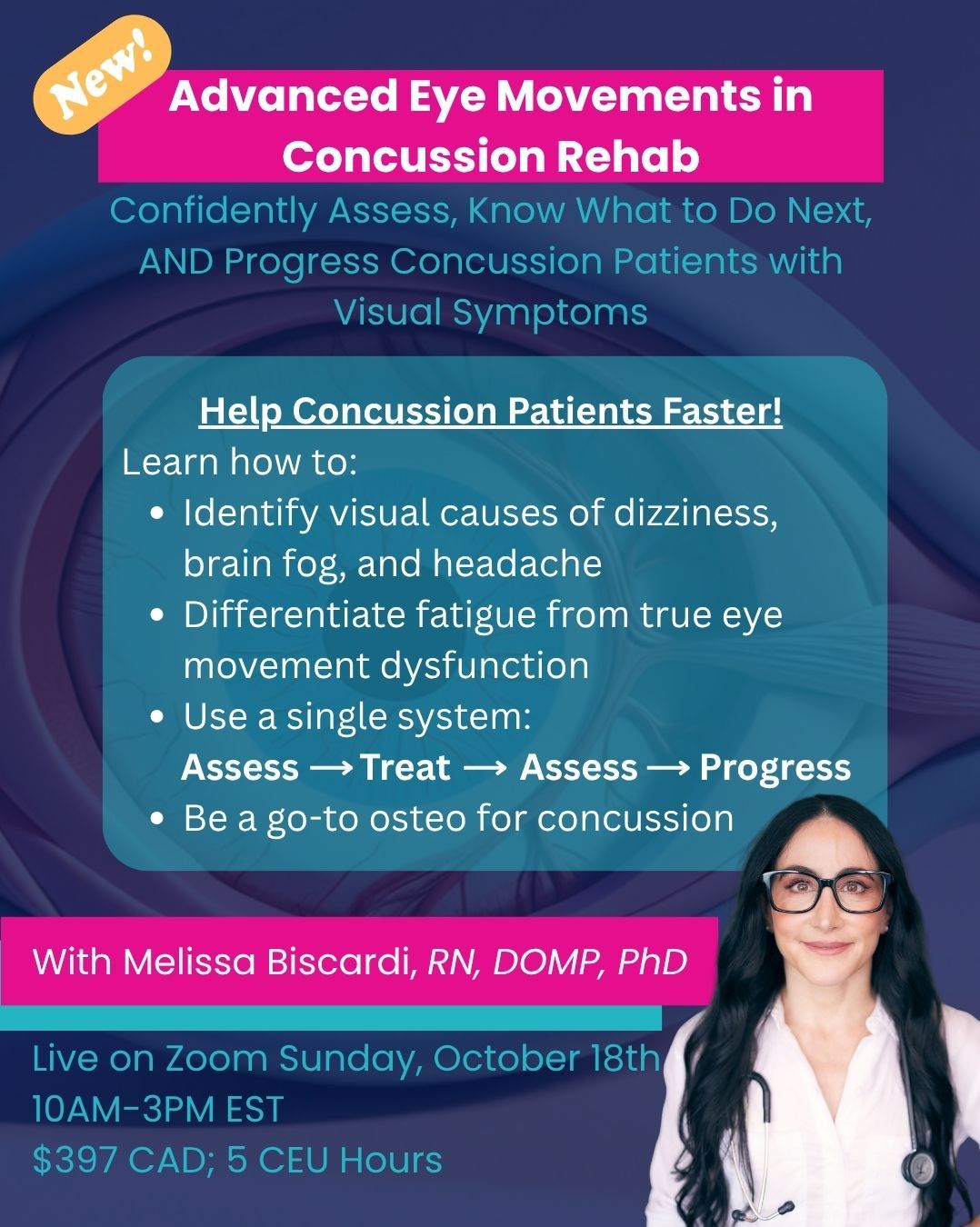
NEW! Advanced Eye Movements After Concussion for Concussion Clinicians
Over 200,000 concussions happen every year and the majority of these involve visual symptoms and eye movement dysfunction. The good news is these respond to active rehabilitation, and early intervention supports faster recovery.
Visual symptoms and eye movement dysfunction are common after concussion. But finding an abnormal pursuit, saccade or convergence test is only the beginning.
What does the finding actually mean? What should you treat? And how do you know what to progress next and when to refer?
That’s where this course goes beyond the basics.
This live on Zoom (with replays), advanced course is designed to help clinicians move from simply looking at eye movements to understanding what they’re seeing and building a targeted rehabilitation plan around it.
We’ll get into:
- The full oculomotor assessment of the 6 eye movement systems, including the subtle findings that are easy to miss
- Fixation vs. gaze stability vs. visual dependence how to tell them apart and why the treatment approach isn’t the same
- Convergence beyond the Brock string including receded and excess convergence, suppression and progressing toward higher-level performance
- Subjective visual vertical what it can tell you about spatial orientation and vestibular function
- Cognitive + visual integration layering attention, working memory and dual-task demands into both assessment and rehabilitation
- Dosing and progression deciding when to slow down, challenge more, change the task or move on
- Athletes + neuroperformance taking eye movement training beyond symptom reduction and toward the demands of sport and performance. Where does eye movement training ACTUALLY fit in and make sense
- The eyes don’t work in isolation integrating the vestibular system, neck and face, including where manual therapy fits into the bigger clinical picture
And most importantly: how to put all of these findings together.
Because concussion rehabilitation shouldn’t be a collection of random eye exercises. The goal is to understand why you’re choosing an intervention, what you’re targeting and how to progress it. Every patient is different with different needs.
Every attendee receives a physical Brainy Tool Kit in the mail to use throughout the course so register early to allow time for the mail to arrive, plus personal access to Brain Tool Kit or PRO depending on your phone.
Live. Interactive. Evidence based.
When: Sunday, October 18
Time: 10am–3pm ET
Where: Live on Zoom + replay access
5 CEU hour certificate
$397 CAD
Instructor: Melissa Biscardi, RN, DOMP, PhD
Hands-on. Practical. Evidence-informed. A little bit brainy.
Register early so your Brainy Tool Kit arrives in time:
https://education.concussionrehab.ca/brainy